
 Blog
Blog
Dealer Spotlight: Clever Cycles in Portland, OR
In addition to being great partners, the folks in our carefully selected dealer network have their fingers on the pulse of their communities and the bike industry - particularly when it comes to electric bikes. So we thought it would be valuable to share their insights, anecdotes and expertise with you through a series of interviews.
Our first is with Dean Mullin of Clever Cycles in Portland, OR. Fitting, as Portland is the honorary birthplace of Faraday (with Faraday founder Adam Vollmer being from Portland and the Oregon Manifest Design Contest being our jumping off point).
Also fitting because Portland has a reputation for being a mecca of biking enthusiasm. In fact, Dean and team were kind enough to supply a bike to Drew Carney of local Portland station KGW for a recent segment on the growing prevalence of bike commuting.
Here’s what Dean had to share with us about his start in the biking world, the joy of putting a smile on someone’s face with a new bike, and his experience with a Faraday last month in San Francisco. (Spoiler alert: There were smiles involved there as well.)
What are your earliest memories of biking or bikes?
I remember seeing a Brooks saddle as a young child. I think even before I was riding a bike myself. I have no idea who's it was. I also remember thumbing through a Bianchi catalog and drooling over a Bianchi Green track bike -- even though I didn’t know what a track bike was at the time. I stopped riding a bike and started driving when I was 16 or 17, which is the case for many at that age. I don't think that needs to happen if you live in a city that provides the infrastructure to allow people to get around by bike safely.
How/why did you end up owning a bike shop?
I’m only a partial owner, so I’ll let you ask the others directly if you wish. Speaking for myself, I was working in the financial industry working East coast hours living on the West coast -- staring at a computer and being stressed out most of the time. To reduce the stress, I used to race myself every night at 10pm on a ride from NE Portland to the top of Mt Tabor and back. I then created a 90 mile loop around Portland and found myself just wanting to ride more and more. I was riding almost 90 miles a day five or six days out of the week. That takes a bit of time. I thought about my life while on those rides and realized that I didn’t want to go back to working in the financial world.
What has been most rewarding thing about being in the bike business?
Watching people smile when they take off on a test ride. We get to see that everyday. Seeing the amount of bikes being used in Portland as transportation. We get to see the part we played in making that happen.
How was Clever Cycles born and how long has it been around?
We opened in June 2007, after our two families became partners to help make Portland an even better place to live and work, slow down in, ride every day. In a town with 70 other bike shops, we expanded our family-friendly shop three times through the recession to 7000 square feet, and in 2012 were named Best Urban Bike Shop in the United States by Bicycle Retailer and Industry News.
Tell us about the neighborhood you’re in, the biking culture of your neighborhood and where you fit into it.
We’re in SE Portland, a few blocks east of the Hawthorne Bridge. Thousands of people ride across the bridge every day to do their thing. Because we’re on a one way street on their way home, we usually see a busy peak in the late afternoon. I like to think of biking culture the way I think of a power drill. I don’t care that much about it. I just want it to work. The more people out there riding will make it safer for all cyclists, no matter what they are into.
Give us a sense of your customer base. Is there a predominant type of customer (family? commuters? Recreational bikers?) or does it run the gamut?
We are Portland’s first and largest bicycle shop devoted entirely to bicycles as primary transportation, serving urban households like ours seeking to avoid dependence on cars with practical, stylish bikes for everyday use: not just “commuting” bikes, but family transport, cargo, and folding bikes, all equipped for comfort, safety, and reliability.
We don’t sell road bikes or mountain bikes, so that weeds out “recreation” for the most part. We do sell bikes that could be considered “sunny day bikes”, but these bikes also function well on the wet days too. Who doesn’t like to ride their bike on a sunny day? We love all types of cycling, but our shop primarily serves the commuter/family market. All the bikes in our store must be able to handle fenders, as well as capable of carrying some stuff in addition to the rider.
What do you feel makes Clever Cycles unique? Is there a guiding philosophy with which you stock the store and service your customers?
We don’t stock items because we think they will sell and we know we’re making a certain margin. Of course they need to sell at a particular rate for us to continue stocking them, but we’re not interested in following a formula that some huge industry powerhouse like Trek or Specialized has proven successful to provide a certain ROI on the items they say we must buy. Boring. We personally have used or would use the products we have in the store. There are of course, traditional rules of business that complete the picture, but we try to question if they are legit, or if they need testing.
Happy customers create more happy customers. Seeing a smile when coming back from a test ride or walking out the door with your new ride is the best part of our day. If we can’t make that happen, then we are not doing our job. We want to help the customer discover the right product that works for them today and tomorrow and five years from now. If we don’t have it, we’ll tell the customer and even offer suggestions on where they might find it. Not only do we refer customers to the stores that can help them when we can't, but we also receive tons of referrals from other shops, because we've earned a reputation for helping our customers solve their unique transportation needs.
Specifically thinking of electric bikes, has adoption been growing? Who do you see most interested in them, and for what use? (Commuting? Errands? Recreation?)
We’re still figuring this out. Portland is not that hilly. In San Francisco, it seems simple. I’ve been riding an electric cargo bike for a few weeks in order to gain knowledge on the system as well as the perceptions. We’ve got a few products that have quite a large group of narrow customer segments that add up to quite a large portion of the overall market. I’m thinking that this will be the case with electric bikes in Portland.
And, of course, we’d love to know how the Faradays have been received. What are customers saying? Where do you see Faraday fitting into the biking landscape?
I knew that we would stock the Faraday when our employees started taking our Faraday demo bike to run errands. In Portland, the Faraday will allow a customer to reach their destination quicker, while riding a bike that does not look like the typical electric bike.
You got the chance to borrow a couple bikes in San Francisco for a weekend. Where did you go and what did you think?
I rode from Faraday’s headquarters to Bernal Heights to say hello to the New Wheel people (talk about a good location for an electric bike shop). I rode up that crazy hill to the park at the top and then continued back to the Richmond neighborhood where I was staying. I got chance to ride through most of the city in the couple of days that we had the bike. I miss San Francisco already. I wouldn’t have covered that many miles of the city without the Faraday.
The most unexpected of places
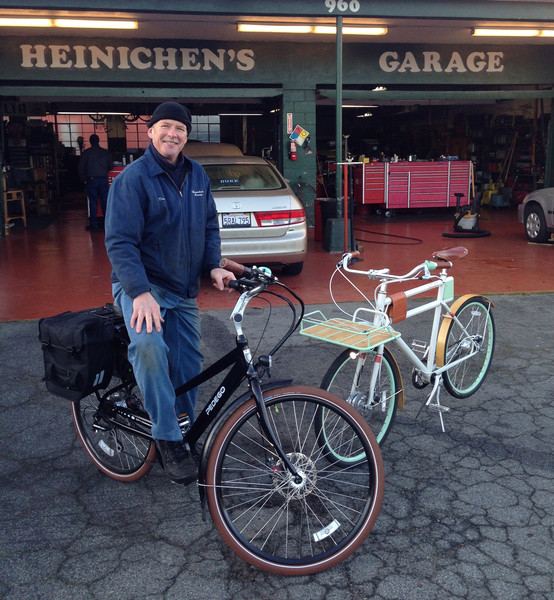
No one is a more fervent e-bike evangelist than a brand new, first-time e-bike customer. Sometimes you meet them in the most unexpected places.
...
I have a love-hate relationship with my car. It's taken me on great adventures and it's an important part of my own personal transportation mix, yet I go out of my way to leave it parked in front of the house and go by foot or by Faraday whenever possible. More trips by e-bike equals fewer cash outlays on gas and oil changes, but more importantly, ditching my car in favor of my Faraday means I am happier, healthier, and less-stressed - and that's worth even more to me than cutting back on the estimated $5k per year that Consumer Reports tells me I'm spending on automotive upkeep.
A big chunk of that annual automotive spending bill comes from semi-regular trips to my local mechanic for upkeep on my aging Mazda. I'm lucky to have had the same car mechanic for the past 6 years ... the kind of local shop that knows me by name and knows my car even better. It's the sort of shop were you can feel good about being a customer, even when you discover that a slashed sidewall is going to set you back for a brand new set of tires.
It was on just such a trip to the automotive garage, this morning, that I spotted a shiny new e-bike in the back of the shop. I asked around and was happily surprised to learn that it belonged to none other than David, the owner of the shop. Just two weeks earlier, he'd sold the gas-guzzling oversized truck he's driven for years and upgraded to an e-bike for his ~4 mile commute to work. He loves the exercise, the opportunity to get outdoors, and the thrill of riding his speedy new bike - he couldn't be happier with his new set of wheels.
I walked home and rode by later in the morning on my Faraday, let David take it for a spin (he loved it), and chatted e-bikes for a bit. He hadn't heard of Faraday when doing his research (shame on us for the missed marketing opportunity) but loved the bike's classic lines and smooth ride. We may have missed the chance to win him as a customer, but now his wife wants an e-bike ... hopefully she has a Faraday in her future.
I rode away with a bigger-than-normal smile on my face, already thinking about this blog post. It's the greatest thing in the world to me that a guy who's lived and breathed automobiles for 30 years or more can so happily walk away from his own car (or truck) and become an electric bicycle evangelist. David's enthusiasm is contagious, and I like to hope that many more of his future customers will come in for an oil change and leave with something far more inspiring - a glimpse of a new alternative for the future of transportation, in the most unexpected of places.
- Adam
Electric bicycles on NPR
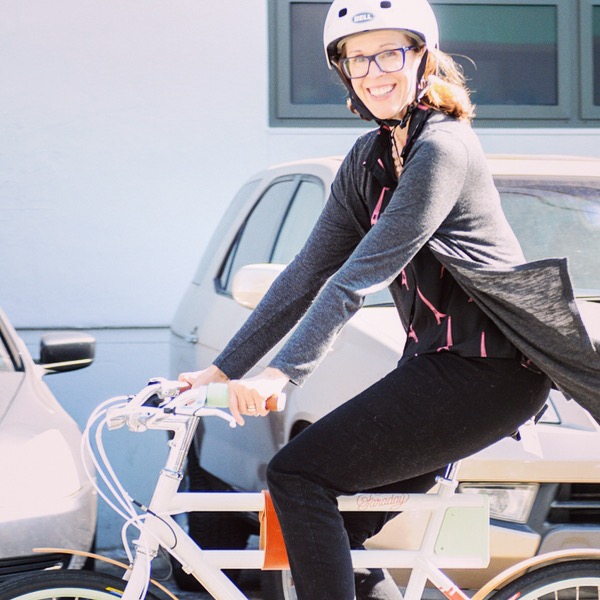
We enjoyed reading this week's All Things Considered, in which NPR reporter Susanna Capelouto interviews Atlanta e-bike commuter Joel Bowman. A central theme of the story is the trajectory of e-bikes in Europe, which originally entered the market primarily among older riders, before being embraced by a much wider and younger audience. E-bikes have in fact become SO successful in Europe that Holland is now considering widening its already ample bike lanes to accommodate the surge of cyclists that e-bikes have added to the roads. It's a common question - when will the popularity of e-bikes take off here in the US? And if it does, who will be the early adopters, what trajectory will the market take, etc. An assumption from the article is that like Europe, older riders (like 66 year old Joel) will be the first to embrace this new form of transportation. This may be true, but just listen to Joel's description of why he is wildly in love with his e-bike to understand why the appeal of electric bicycles transcends age:
"The real contrast is the old [non-electric] bike, somethings I got a little, 'Arghh, I gotta bike home, I'm tired,' " he says. "This, I just look forward to being on because it is pure fun."
Whether 66 or 36, who hasn't, at the end of a long day or work, resented the prospect of riding home after a long day at the office? Commuting by bicycle is a wonderful experience, a welcome opportunity to stretch the legs, lungs, and mind before or after a long day of work, and for many of us, the highlight of our work day (how many people can say that about our commute??). That said, we can all relate to the feeling of begrudging our bicycle after an especially long day - or worse yet, being tempted to choose the car over the bike at the start of our daily commute. Joel's comment says it best - a great electric bicycle elevates the experience of cycling, and if you're a commuter, helps ensure that that daily ride to and from work is always a highlight of your day that you'll simply look forward to.
Susanna cites the statistic that only 1% of Americans (about 3 million people) regularly bike to work as an example that the market for electric bicycles in the US is limited. Certainly, even another 0.5% of Americans would be a welcome addition - but at the same time, there is a lot of potential in those numbers. That's because only 150,000 electric bicycles were sold in the US last year. Or in other words, less than 5% of those 3 million American bicycle commuters are riding e-bikes. I can attest from personal experience that the vast majority of the remaining 95% have never even ridden, much less considered, an ebike. And that right there is an incredible opportunity; to show the population who has the most to gain from an electric bicycle - those 2,850,000 American bike commuters - what they're missing. (Not to mention the other 99% of Americans who don't yet bike to work!)
So with that said, if you live in the bay area, sign up for our brand new demo program and try a Faraday on your commute to work. If you're outside the bay, get in touch to find out about test ride opportunities near you, or pre-order your Faraday Porteur. Our next limited edition batch of bicycles ships in March, and with free shipping and our 30-day return policy you can be sure that you'll have the opportunity to fall in love with your Faraday before you commit to becoming a lifetime owner. Get on board and join Joel ... and Mike, Stuart, Amo, Tiffany, Matt, Jean, Echo, Chris, and the many, many others in the Faraday family who are happy e-bike converts. We know you won't look back.
Subscribe Follow Us
Recent Articles
- Dealer Spotlight: Clever Cycles in Portland, OR
- Bike to Work Day 2015
- April showers bring May Faradays
- Let the fun begin: Faradays are here!
- A year in the Life of a Bike Brand
Tags
- anthropologie (1)
- build (1)
- Clever Cycles (1)
- commuting (6)
- demo (1)
- design (1)
- design thinking (1)
- design/build (2)
- electric bicycle market (3)
- electric bike dealers (1)
- electric bike shops (1)
- Electric Bikes (3)
- faraday owners (3)
- faraday staff (2)
- fun (3)
- gift guides (2)
- give-away (1)
- holidays (3)
- manufacturing (1)
- oregon manifest (1)
- Portland (1)
- press (1)
- process (1)
- testimonials (2)
- ulility (1)
- utility (1)
- welding (1)
 © 2015 Faraday Bicycles Inc. Designed in San Francisco
